
Key takeaways
- Ramp Economics data shows token use rising while average business spending falls.
- The author attributes falling costs partly to cheaper models performing many tasks adequately.
- Frontier model providers may face profit pressure if token prices fall faster than usage grows.
- Hyperscalers and infrastructure suppliers face mixed opportunities and risks; delayed data-centre projects could hurt some suppliers.
I was reading the financial news this morning and came across a number of articles saying that SpaceX was lowering the cost of renting or using some of its chips by 15–25%, while at the same time, Anthropic was considering ending its compute agreement and Google was considering doing the same thing with the company.
Up until now, we have all been led to believe that demand for compute is off the charts and that companies couldn't create data centres fast enough to keep up.
So either the laws of supply and demand have been repealed, or something else is going on.
So I did some digging and found some data that I think Anthropic is glad wasn't common knowledge last week when it went public.
Here's a chart that shows the problem:
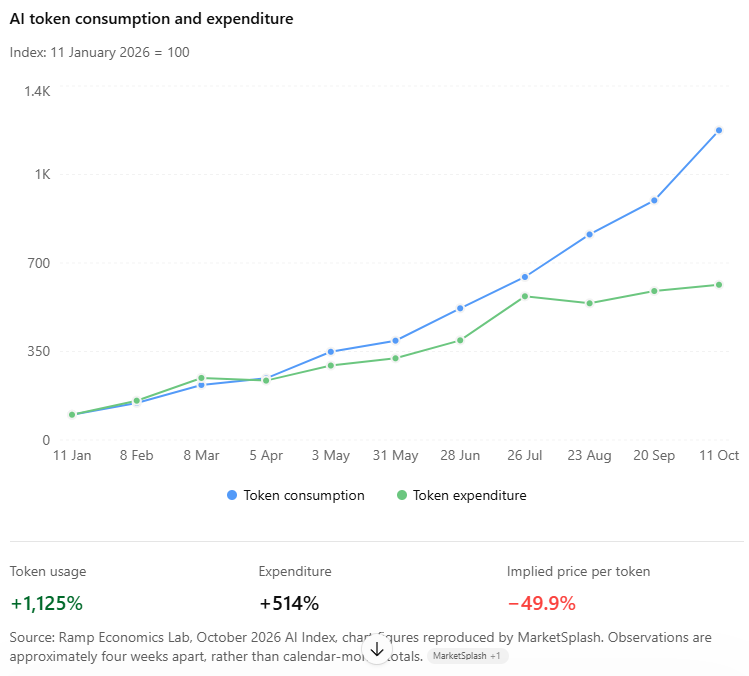
The chart is from Ramp Economics, a company that measures AI usage across 85,000 predominantly US businesses. It shows tokens used and expenditure on those tokens throughout 2026.
You can see that token usage is showing steady, linear growth that is not slowing down—that's the blue line.
The green line, representing cost, shows that the average amount companies are paying to do this ever-increasing amount of work is falling. Not just by a little, but by a lot.
Why such a big fall in prices?
This comes down to what I have been talking about for a few weeks now—the models we have now are good enough to do most of the tasks set for them.
Take our own platform at MyStockScanner: I recently set up a "beauty parade" of 16 AI models to work out which models we should be using for the different tasks we do here. I ran about 30 tests, from researching and analysing a series of stocks and creating a screened list of stocks with low PE ratios to translating languages.
The best model in all but one of the tasks was ChatGPT Luna—OpenAI's cheapest model. It was as good, or very nearly as good, as its much more expensive counterparts and competitors at performing some fairly complex tasks.
For us, this is great news—we get to run our AI tasks 98.75% cheaper than we thought we would:

For the companies that sell us AI, that's not so good.
What does this mean for Anthropic and OpenAI?
To make the big profits these frontier model companies have promised, they need spending to keep increasing.
For them, this means that the success of their cheapest models, Luna and Haiku, actually makes it much more difficult to grow their profits.
A 50% decline in token prices requires token usage to grow by 100% just to maintain current revenues. If they are entering a pricing war, prices could continue to fall as this section of the AI world gets commoditised.
It also makes it much more difficult to justify continued spending on more complex models if the current, cheaper ones are good enough.
So, for Anthropic, the key things to watch are revenue growth, cash burn and compute requirements (such as dropping capacity sourced from SpaceX).
What does this mean for hyperscalers?
Hyperscalers are more complex beasts, as this may mean they can reduce their huge capital expenditures on AI, which would be a big hit with investors.
- Microsoft's big opportunity is Azure data centre growth, together with integrating its own AI, Copilot, into its huge enterprise customer base. Its risk is getting a return on investment (ROI) on its current investment, but it is well positioned in this new "AI is good enough" world.
- Alphabet's main opportunity is its Gemini AI family of models, which it can integrate into its cloud products and retail offerings, as well as its proprietary chips. Its risks, in addition to ROI, include any disruption to its search income, either from its own AI or from external companies.
- Amazon operates the largest cloud system in the world and also has its own Trainium chips. Its biggest risks are ROI and cash burn, so taking its foot off the investment gas could be good for its share price.
- Meta has to date reaped some of the biggest business rewards from AI, since it has integrated it into its ad systems with encouraging results. But it is operating at a disadvantage because it is building cloud compute resources to keep up with its competitors. Could this investment be too late?
- Oracle has an opportunity to rent its infrastructure to others, but that is about it. The risks for this company, apart from the staggering cash requirement compared to its revenues, include customer concentration: it has a few big clients that make up a large part of its income.
Infrastructure stocks
Stocks like Dell, Vertiv, Schneider Electric and REITs like Equinix and Digital Realty are an important part of the AI build-out, but could well be affected by a second wave of risk.
These companies are currently benefiting from large backlogs of orders and may continue to report good revenues for a few quarters while the AI prospects deteriorate due to ongoing customer contracts. If data centres are delayed or cancelled—a very likely prospect—this could lead to a big drop for stocks that rely on large AI revenue streams.
Semiconductor Stocks
One reason costs per token are coming down is that semiconductor companies are designing chips that are better suited to the workloads their clients are now using them for.
For example, Nvidia's new Vera Rubin chip is estimated to handle inference tasks at a 90% cost reduction compared to its previous Blackwell chips. So, it is giving its customers a way to 10x their compute for 2x the cost.
Based on these calculations, Nvidia's revenues should remain stable if token demand grows by 100% a year, and should increase by 50% if token demand grows by 200%.
AMD is a competitor and has grown its market share in AI this year to ~10%. Its new MI455X GPUs are reported to be 20x as powerful as their predecessors and are claimed to be better than the new Nvidia offerings.
This gives the company a good platform to grow its market share among a customer base that is eager to diversify some of its compute away from Nvidia.
Conclusion
The latest token usage and expenditure data paints an interesting picture and potentially changes the investing landscape when we consider what could happen in the next 1–2 years.
The frontier model providers have more to lose than to gain from this, but could pivot from their goal of ever-better AI models to making better use of what they have now to adapt to this change.
The hyperscalers have a more mixed set of opportunities, but Microsoft would be my pick of the bunch based on the potential of implementing Copilot for its enterprise clients.
Chip companies Nvidia and AMD stand to benefit from this, since making AI cheaper should lead to customers demanding to use it more. TSM will also benefit, since it actually makes the chips, and ASML to a lesser extent, since it builds the machines that build the chips.
As usual, though... expect volatility on the way.
Happy investing!
Frequently asked questions
What does the article say the Ramp Economics data shows about AI token use and spending?
The article says Ramp Economics measures AI usage across 85,000 predominantly US businesses. Its chart, covering 2026, shows token use rising steadily while the average amount businesses pay for tokens is falling. The article presents this as evidence that usage can grow even as the cost of AI work declines.
Why might falling token prices put pressure on frontier AI model providers?
The article argues that providers such as Anthropic and OpenAI need spending to keep increasing to deliver the large profits they have promised. If cheaper models such as Haiku and Luna can handle many tasks well, customers may have less reason to pay for more expensive models. The article notes that a 50% decline in token prices would require token use to grow by 100% just to maintain current revenue, and says a pricing war could put further pressure on prices.
Which risks and opportunities does the article identify for AI-related companies?
The article says hyperscalers may have an opportunity to reduce large AI capital expenditures, but face questions about returns on investment; it highlights Microsoft’s potential to integrate Copilot with enterprise customers. It sees infrastructure companies as exposed if data-centre projects are delayed or cancelled, even if existing order backlogs support revenue for a few quarters. For chipmakers, it argues that lower costs could encourage greater AI use: it cites estimates for Nvidia’s Vera Rubin and claims about AMD’s MI455X, while noting that the outcomes depend on token-demand growth and customer adoption.