
Dell reports earnings tomorrow, which is why it was chosen as today’s stock. It is also relevant following today’s news from Nvidia, where Jensen Huang is now making his return to the executive suite. Let’s see whether Dell could be interesting as well.
3-Point Playbook
Point 1 – Is this a quality stock?
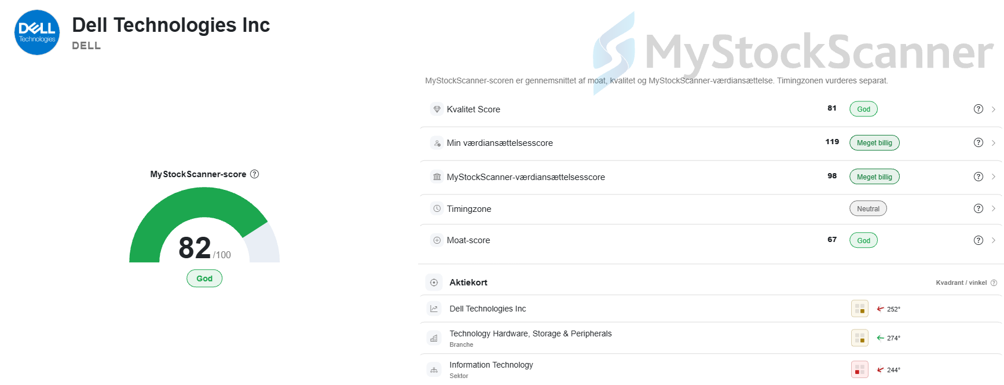
There is no doubt that DELL is an interesting stock based on our initial overview here alone. It has an overall score of 82 and a quality score of 81, so there is plenty to dig into. Let’s take a closer look.
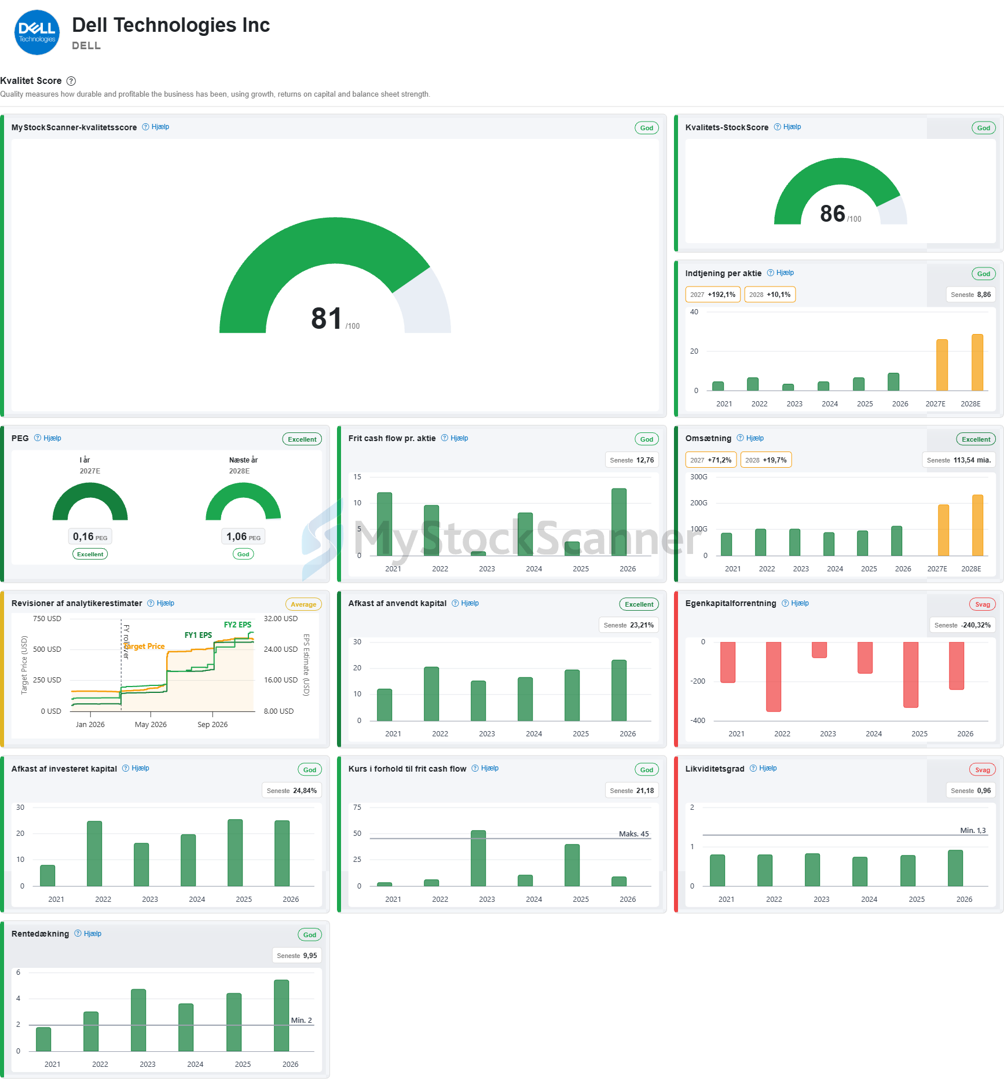
There is no doubt that the quality score of 81 is well deserved. The stock has explosive revenue and earnings growth, which is also reflected in a PEG of 0.16 this year and 1.06 next year. That looks quite impressive. Cash flow is somewhat variable, but positive in every year.
Analysts have raised their estimates for the company several times this year, and its return on capital is impressive. Its negative return on equity is not something to be too concerned about.
This is due to an accounting technicality related to share buybacks.
The current ratio is around 1, and interest coverage is solid at almost 10.
All in all, there is nothing to fault here.
Point 2 – Does the stock have good potential?
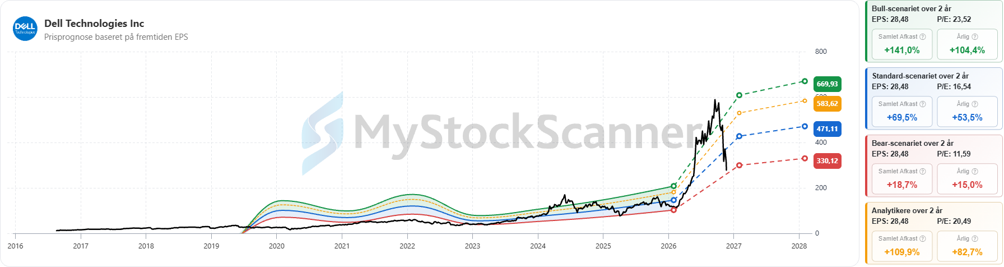
Dell has traded at PE ratios of 11–16 for many years. We have to acknowledge that the entire AI wave has lifted this type of stock considerably, so we have chosen a bear case of 11.6, a base case of 16.5 and a bull case of around 23.5.
Analysts’ average PE is around 20.5, so these assumptions seem to be roughly in line. With these PE ratios, the potential ranges from +18.7% to as much as +141%. That gives us some margin of safety to draw on if something goes wrong.
As we can see below, DELL (like all the others in the industry) has taken a beating in recent months, and it is now at an interesting level relative to its PE ratios in the past.
Point 3 – Is now the time to buy the stock?
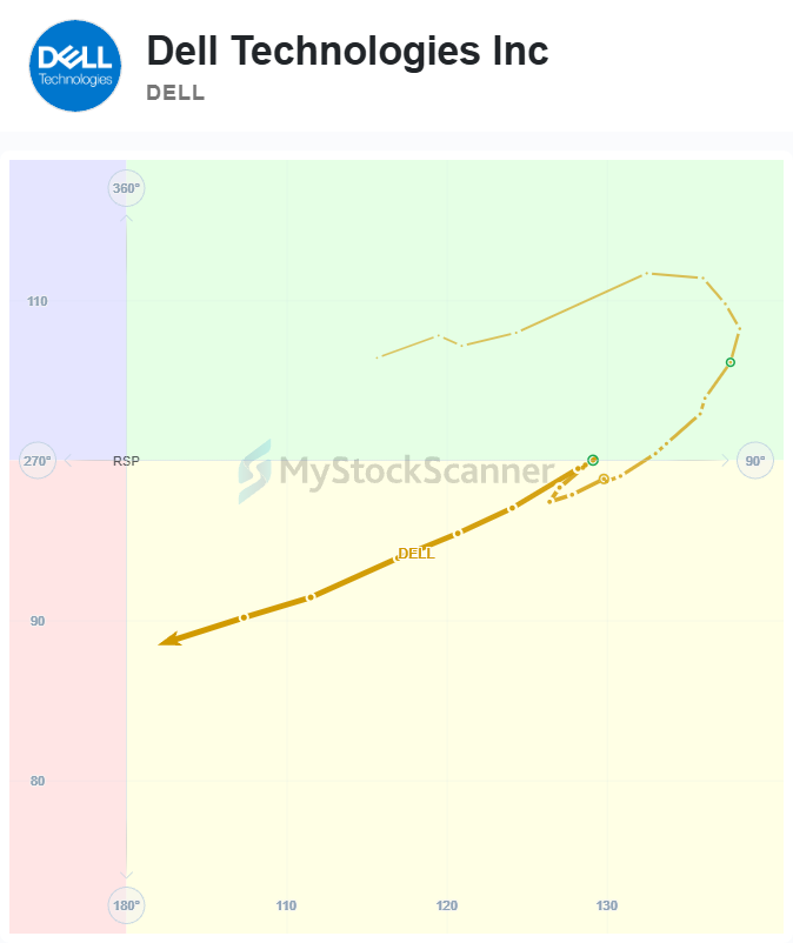
As we can see in the StockMap below, the share price is still pointing sharply down and to the left, which is not a signal we like. We want to see a Buy, Strong Buy or Conviction Buy, and we do not have that right now. The share price is up 20% today in a bullish tech market, though, so who knows what will happen tomorrow. But as things stand right now, it is not a stock we would buy.
A little more about the company
Dell Technologies is an American technology company that most people still associate with computers, but its investment case has changed dramatically. Today, Dell is one of the world’s largest suppliers of AI servers, data-center infrastructure, storage and networking, and serves as a key hardware partner for companies including Nvidia and AMD. At the same time, the company still has a huge PC business, particularly serving enterprises. The AI boom has sent growth soaring, and Dell now expects nearly $200 billion in revenue in FY2027. The stock trades on the NYSE under the ticker DELL.
The strategic pillars
AI servers have become by far the most important growth engine. Dell builds complete server and rack systems around, among other things, Nvidia GPUs, and supplies them to hyperscalers, businesses, governments and AI infrastructure projects.
Dell AI Factory brings servers, storage, networking, software and services together in one solution. The strategy is for customers to buy not just the GPU server, but the entire infrastructure surrounding their AI system.
The Infrastructure Solutions Group also includes traditional servers, storage and networking. The AI boom is also driving demand for these other products, because an AI data center requires far more than GPUs alone.
The Client Solutions Group remains a very large PC business. Dell is particularly strong in commercial PCs for businesses and public-sector customers.
Dell Financial Services finances customers’ purchases of hardware and infrastructure. This becomes more relevant when AI systems cost millions or billions of dollars and customers want to spread payments over several years.
What are its strengths?
AI growth is extreme. In Q2 FY2027, Dell generated $16.4 billion in revenue from AI-optimized servers alone, twice as much as a year earlier.
Order intake is even more striking. Dell received around $60.9 billion in AI server orders in Q2 and ended the quarter with an AI backlog of approximately $95 billion.
This provides very high visibility. Even if new AI orders were to fall significantly, Dell already has a huge volume of existing orders that need to be converted into revenue.
Infrastructure Solutions Group grew 89% in Q2 to a record $31.8 billion. The segment’s operating income grew even faster—225% to $4.8 billion.
AI growth is spreading to the rest of the data-center business. Traditional servers and networking grew 122%, while storage grew 26%.
The PC business has also picked up again. Client Solutions Group grew 20% in Q2 to $15.0 billion, while commercial client revenue rose 22% to a record $13.2 billion.
Dell continues to generate significant cash flow. Operating cash flow was around $6.3 billion in the first half of FY2027.
The company is returning capital to shareholders aggressively. In Q2 alone, around $4.3 billion was returned through share buybacks and dividends.
What are its weaknesses?
AI servers are not necessarily a high-margin business. A very large portion of the selling price consists of expensive GPUs from Nvidia and other components, where Dell does not own the technology itself.
This means that an extra dollar of AI server revenue is not necessarily as valuable as an extra dollar of software or service revenue.
Dell is therefore highly dependent on Nvidia. If Nvidia changes its distribution strategy, or customers increasingly buy directly from other systems providers, Dell could come under pressure.
Working capital has surged. Dell’s inventory increased from approximately $10.4 billion at the beginning of the fiscal year to $21.3 billion at the end of Q2.
A large part of the inventory consists of expensive production components for AI servers. This is necessary to fulfill the enormous backlog, but it also ties up a lot of capital.
This also creates risk if demand suddenly falls. AI hardware evolves quickly, so old inventory can lose value faster than traditional PC hardware.
The PC business is sensitive to economic conditions. Companies may postpone PC upgrades if the economy weakens.
Competition in AI servers is fierce. Dell faces companies including Super Micro, HPE, Lenovo and specialized ODM manufacturers.
What do analysts generally think of the company?
Analysts are mostly positive. The consensus is around Buy, and the average 12-month price target is around $575–580.
However, the range is very wide. Recent price targets are roughly between $400 and $700, showing how different expectations are for the long-term growth and earnings of AI servers.
The key discussion is no longer whether Dell can sell AI servers. Demand is clearly enormous. The question is how much profit Dell can earn from this explosive revenue growth, and how long AI investment can continue at the same pace.
How is the company exposed to macroeconomic factors?
Hyperscalers’ AI investments are the most important factor. Microsoft, Meta, Amazon, Google and others are spending huge sums on data-center infrastructure, which indirectly drives demand for Dell.
Nvidia’s production capacity is crucial. Dell cannot deliver an AI server without the necessary GPUs, memory and networking components.
Memory prices matter more than they used to. AI servers contain huge amounts of DRAM and storage, so rising memory prices can squeeze hardware margins if Dell cannot pass on the costs quickly.
Interest rates affect enterprise investment. Very large data-center projects require substantial capital, and higher financing costs can make some projects less attractive.
A recession can hit the PC business and traditional IT investments, even though AI investment may develop differently from the broader economy.
Trade restrictions between the US and China are a risk because advanced AI chips and servers have become a central part of the geopolitical technology rivalry.
The dollar also matters because Dell sells globally but reports in US dollars.
Things to be aware of
The most important event is already tomorrow, November 24, 2026, when Dell will publish its Q3 FY2027 results after the US market closes.
Management’s own Q3 guidance is around $49 billion in revenue, equivalent to approximately 81% growth from a year earlier.
Non-GAAP EPS is expected to be around $6.50, compared with $2.59 a year earlier.
The market expects roughly the same level and will focus especially on AI server revenue, backlog and margins.
Dell itself expects around $19 billion in AI server revenue in Q3.
The current full-year guidance is extraordinary. Dell expects around $192 billion in FY2027 revenue—an increase of approximately 69% from FY2026.
The full-year AI server revenue expectation has been raised to around $74 billion. By comparison, at the beginning of the year Dell expected a substantially lower level.
Non-GAAP EPS is expected to be around $25.50 for FY2027, almost 150% higher than a year earlier.
The $95 billion backlog may be the most important figure in the entire investment case. It shows how much demand has already been contracted, but it also creates enormous requirements for inventory, suppliers and financing.
Inventory of $21.3 billion is therefore worth monitoring very closely. It has more than doubled since January.
The balance sheet looks more debt-heavy than it really is. Total debt was approximately $34.5 billion at the end of Q2, but around $20.7 billion was related to Dell Financial Services and financing customers’ hardware purchases. So-called core debt was around $14 billion, compared with approximately $11.6 billion in cash.
The stock has been extremely volatile. It fell sharply through November along with the rest of the AI sector, but today it has risen more than 20% amid a dramatic comeback in AI stocks just ahead of the earnings report.
Even after today’s big rise, the stock remains well below its high for the year.
At a share price of around $330–350, Dell trades at roughly 12–14 times its current FY2027 non-GAAP EPS guidance. That is a surprisingly moderate multiple given the enormous earnings growth, but it also reflects the market’s uncertainty about how sustainable this growth is.
The central investment case for Dell is AI infrastructure.
AI is often associated with Nvidia, but a GPU alone does not make a data center.
The GPUs need to be installed in servers. The servers need to be connected through networking. Data needs to be stored. The systems need to be cooled, managed and financed.
This is where Dell comes in.
The company is increasingly serving as the business that packages AI technology into complete systems that companies can actually install and use.
And right now, demand is extraordinary.
A $95 billion AI backlog is a level that would have been hard to imagine for Dell just a few years ago. It is almost the size of Dell’s entire annual revenue before the AI boom.
But there is an important difference between Dell and, for example, Nvidia.
Nvidia owns the most valuable technology in the system and has extremely high gross margins.
Dell assembles the system.
That is a far more competitive and capital-intensive position.
That is why looking at revenue growth alone is not enough. Investors should pay particular attention to how much operating income and cash flow Dell can generate for each additional billion dollars of AI server revenue.
If Dell can maintain or increase its margins while AI server revenue grows toward $74 billion, earnings could continue to grow extremely quickly.
If competition instead puts pressure on AI server margins, Dell could end up with impressive revenue figures but far less impressive economic value creation.
That is precisely why tomorrow’s Q3 earnings report will be so interesting.
I would particularly watch four things: AI server revenue, the development of the $95 billion backlog, ISG margins and cash flow.
If all four develop positively at the same time, it would be a strong sign that Dell has become not only a major AI server supplier, but also one of the big economic winners in the AI infrastructure boom.